
The Difference Between a Filling, Crown, and Onlay
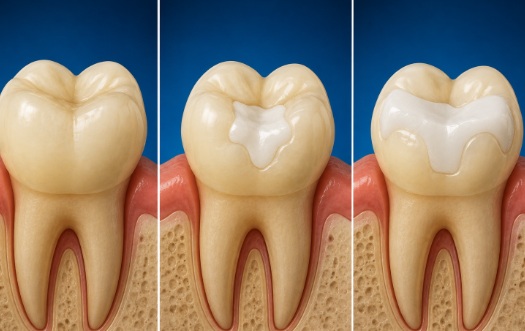
A damaged tooth does not always need the same type of repair.
Sometimes a small filling is enough.
Sometimes the tooth needs a crown.
Sometimes an onlay fits in the middle.
That is why dental treatment can feel confusing. You may hear different terms and wonder why one tooth needs a filling while another tooth needs something stronger.
At Bronte Road Family Dental in Oakville, we often explain it this way. A filling, crown, and onlay all restore teeth, but they protect different amounts of tooth structure.
Why Teeth Need Restorations
A tooth may need repair when part of it has been damaged.
Common reasons include:
- Cavities
- Cracks
- Broken edges
- Old fillings breaking down
- Large areas of decay
- Tooth wear
- Injury
- Weak tooth structure
- Pain when biting
- Food trapping
The right restoration depends on how much healthy tooth remains, where the damage is, how your bite works, and how much pressure the tooth handles.
A back molar that chews hard food needs different support than a small front tooth chip.
What Is a Filling?
A filling is usually used when the damaged area is smaller.
Your dentist removes the decay or damaged tooth structure, cleans the area, and fills the space with a dental material. Tooth-coloured composite fillings are common because they can blend with the natural tooth.
A filling may be recommended when:
- The cavity is small to moderate
- There is enough healthy tooth around the cavity
- The tooth walls are still strong
- The bite pressure is manageable
- The damage does not involve large cracks
- The tooth does not need full coverage
Fillings are common, practical, and often conservative.
They repair the damaged area without covering the whole tooth.
When a Filling May Not Be Enough
A filling works best when the tooth has enough strength left.
If the cavity is large, the tooth walls may become thin. If a tooth already has a large old filling, replacing it with an even larger filling may not protect the tooth well enough.
A filling may not be ideal if:
- Too much tooth structure is missing
- The tooth has cracks
- A cusp is weak or broken
- The filling would be very large
- The tooth has repeated fractures
- The bite puts heavy pressure on the area
- The tooth already had root canal treatment
- An old filling keeps breaking
In those cases, your dentist may discuss an onlay or crown.
The goal is not only to fill a hole. The goal is to protect the tooth.
What Is an Onlay?
An onlay is a custom restoration that covers part of a tooth.
It is often used when a tooth needs more support than a filling can provide, but does not need a full crown. An onlay may cover one or more cusps, which are the raised chewing points on a back tooth.
Think of it as a middle option.
It is more protective than a basic filling, but usually more conservative than a crown because it does not cover the entire tooth.
An onlay may be recommended when:
- A cavity is too large for a filling
- A cusp is cracked or weak
- An old filling is failing
- A tooth needs stronger chewing support
- There is still enough healthy tooth to avoid a crown
- The dentist wants to preserve more natural tooth structure
Onlays are usually made outside the mouth from a scan or impression, then bonded to the tooth.
How an Onlay Is Different From a Filling
A filling is placed directly into the tooth.
An onlay is custom-made to fit the damaged part of the tooth.
A filling usually repairs a smaller area. An onlay can rebuild a larger chewing surface and protect weakened cusps.
The difference often comes down to strength and coverage.
A filling may be enough when the tooth is still strong.
An onlay may be better when part of the chewing surface needs reinforcement.
What Is a Crown?
A crown covers the tooth like a cap.
It is used when a tooth needs more protection than a filling or onlay can provide. A crown can restore shape, strength, bite, and appearance when the tooth is weak, cracked, heavily filled, or badly damaged.
A crown may be recommended when:
- A tooth has a large cavity
- A tooth is cracked
- A large filling has failed
- Too much tooth structure is missing
- A tooth has had root canal treatment
- A tooth is badly worn
- A tooth keeps breaking
- A crown is needed to support a bridge
- The tooth needs full coverage protection
A crown does not make a tooth indestructible. The natural tooth underneath still needs good brushing, flossing, and regular checkups.
But when a tooth is weakened, a crown can help protect it from further breakdown.
How a Crown Is Different From an Onlay
An onlay covers part of the tooth.
A crown covers the whole visible part of the tooth above the gumline.
That is the main difference.
An onlay may preserve more natural tooth structure when the damage is limited to part of the tooth. A crown may be better when the tooth needs full coverage because it is cracked, weak, heavily restored, or at higher risk of breaking.
Your dentist may consider:
- How much tooth is left
- Whether the cusps are strong
- Whether cracks are present
- How deep the decay is
- How large the old filling is
- How your bite lands on the tooth
- Whether the tooth had root canal treatment
- Whether the tooth can hold the restoration well
The best option depends on the tooth, not just the name of the treatment.
A Simple Way to Compare Them
Here is a simple comparison:
A filling repairs a smaller damaged area.
An onlay repairs and protects a larger part of the tooth.
A crown covers and protects the whole tooth.
Another way to think about it:
Filling: smaller repair
Onlay: partial coverage repair
Crown: full coverage repair
This does not mean one is always better than the others.
It means each one has a different job.
Why Your Dentist May Recommend One Over Another
Your dentist is not only looking at the cavity.
They are looking at the whole tooth.
A treatment recommendation may be based on:
- Cavity size
- Crack risk
- Tooth strength
- Old filling size
- Bite pressure
- Tooth location
- Gum health
- Remaining enamel
- Sensitivity
- Past dental work
- Grinding or clenching
- Long-term protection
A small cavity in a strong tooth may need a filling.
A larger damaged area on a molar may need an onlay.
A cracked tooth with thin remaining walls may need a crown.
Bite Pressure Matters
Back teeth handle heavy chewing forces.
If a restoration cannot handle the pressure, it may chip, crack, loosen, or fail. This is why your dentist checks your bite before and after treatment.
Bite pressure matters more if you:
- Grind or clench
- Have cracked teeth
- Have worn teeth
- Have large old fillings
- Bite hard foods often
- Have had restorations break before
- Wake up with jaw soreness
- Have morning headaches
If grinding or clenching is part of the problem, your dentist may recommend a nightguard to protect the restoration.
Old Fillings Can Change the Treatment Plan
A tooth with an old filling may need more than another filling.
Over time, old fillings can wear, crack, leak, or loosen. The tooth around the filling can also develop new decay. If the old filling is large, the remaining tooth may be weaker than it looks.
Your dentist may recommend an onlay or crown if:
- The old filling is very large
- A cusp is cracked
- Food keeps trapping
- The filling keeps breaking
- The tooth hurts when biting
- The tooth has decay around the filling
- The remaining tooth walls are thin
The goal is to avoid repeating a repair that may not last.
Why X-Rays and Exams Matter
You cannot always see how much tooth is damaged.
A tooth may look fine from the outside but have decay between teeth, under an old filling, or near the nerve. A crack may also be hard to see without a careful exam.
Your dentist may use:
- Visual exam
- X-rays
- Bite testing
- Cold testing
- Gum measurements
- Photos
- Existing filling evaluation
- Crack detection tools
This helps your dentist choose a restoration that fits the real condition of the tooth.
Which Option Looks the Most Natural?
Fillings, onlays, and crowns can all be made to look natural, depending on the material and the case.
Tooth-coloured fillings can blend with enamel.
Ceramic onlays can match the chewing surface of a back tooth.
Porcelain or ceramic crowns can be shaped and shaded to match nearby teeth.
Natural-looking results depend on:
- Shade match
- Tooth shape
- Bite fit
- Surface texture
- Gumline
- Material choice
- Tooth location
- Existing dental work nearby
For front teeth, appearance may be a bigger part of the discussion. For back teeth, strength and bite pressure may matter more.
Both appearance and function count.
Questions to Ask Your Dentist
If your dentist recommends a filling, crown, or onlay, ask questions.
Helpful questions include:
- How much tooth structure is left?
- Is the tooth cracked?
- Is the old filling failing?
- Why is a filling not enough?
- Why is an onlay better than a crown in this case?
- Why is a crown needed?
- What material do you recommend?
- How long should this last?
- Will my bite affect it?
- Do I grind or clench?
- Will I need a nightguard?
- What happens if I wait?
A good explanation should make the choice clearer.
You do not need to know the perfect treatment name. You need to understand why your tooth needs that level of protection.
When to Book a Dental Visit
Book a dental visit if you notice:
- Pain when biting
- Cold sensitivity
- Sweet sensitivity
- A broken filling
- A loose filling
- Food stuck in the same spot
- Floss catching or shredding
- A cracked tooth
- A rough edge
- A dark line around a filling
- A tooth that feels weak
- A piece of tooth breaking off
- A crown that feels loose
Do not wait for severe pain.
Small cracks, failing fillings, and early decay are usually easier to manage before the tooth breaks further.
How Bronte Road Family Dental Can Help
Bronte Road Family Dental in Oakville can help you understand whether a filling, onlay, or crown makes sense for your tooth.
Your dental team can check:
- Cavity size
- Tooth strength
- Cracks
- Old fillings
- Bite pressure
- Gum health
- Sensitivity
- X-rays when needed
- Grinding signs
- How much tooth structure remains
If you are comparing fillings, onlays, or dental crowns in Oakville, your dentist can explain the pros and cons clearly.
Sometimes a filling is enough.
Sometimes an onlay preserves more tooth while adding strength.
Sometimes a crown gives the tooth the full protection it needs.
The goal is to restore the tooth in a way that fits the damage, the bite, and your long-term oral health.
The Bottom Line
Fillings, crowns, and onlays all repair teeth, but they do different jobs.
A filling repairs a smaller damaged area.
An onlay covers and protects part of a tooth when the damage is larger.
A crown covers the whole tooth when it needs stronger protection.
The right choice depends on how much tooth is left, how strong the tooth is, where the damage is, and how your bite works.
Ask your dentist why one option is being recommended over another.
The best restoration is not always the biggest one.
It is the one that protects the tooth properly while preserving as much healthy structure as possible.
External Sources
Canadian Dental Association, Tooth-Coloured Fillings: https://www.cda-adc.ca/en/oral_health/procedures/fillings/tooth-coloured.asp
Canadian Dental Association, Crowns: https://www.cda-adc.ca/en/oral_health/procedures/crowns/
Cleveland Clinic, Dental Crowns: https://my.clevelandclinic.org/health/treatments/10923-dental-crowns
Cleveland Clinic, Dental Restorations: https://my.clevelandclinic.org/health/treatments/10924-dental-restorations
FAQ
What is the main difference between a filling, crown, and onlay?
A filling repairs a smaller damaged area. An onlay covers and protects part of a tooth. A crown covers the whole visible part of the tooth.
When is a filling enough?
A filling may be enough when the cavity or damage is smaller and the tooth still has enough healthy structure to support chewing.
When would I need an onlay?
An onlay may be recommended when the tooth needs more protection than a filling can provide, but still has enough healthy structure to avoid a full crown.
When is a crown needed?
A crown may be needed when a tooth is cracked, weak, heavily filled, badly decayed, worn down, or needs full coverage protection.
Is an onlay better than a crown?
Not always. An onlay may preserve more tooth structure in some cases, but a crown may be better when the tooth needs full coverage. The right choice depends on the tooth.
Can a filling turn into a crown later?
Yes. If a filled tooth develops more decay, cracks, or loses more tooth structure over time, it may later need an onlay or crown.